



Choosing the right Shopify development partner can have a direct…
Read More

Quick Summary
Starting an online business often feels confusing, especially when you have to choose the right platform. With so many eCommerce options available today, Shopify and Etsy stand out as two of the most popular choices for sellers worldwide. Both platforms can help you generate revenue, but they operate in very different ways and are designed for different types of businesses.
Shopify allows you to build your own independent online store where you control everything from branding to customer experience. Etsy, on the other hand, is a marketplace where you list products alongside millions of other sellers and benefit from an existing audience. Understanding these differences is crucial before deciding which platform aligns with your business goals.
In this detailed guide by Memento Tech, we compare Shopify and Etsy based on pricing, features, customization, scalability, marketing potential, and long-term growth. By the end of this article, you will have a clear understanding of which platform is best suited for your online business in 2026.
The fundamental difference between Shopify and Etsy lies in ownership and control. Shopify is a standalone eCommerce platform that allows you to create a fully customized website under your own domain. You own your store, your brand identity, and your customer data. Every aspect of your online shop, from design to checkout experience, is under your control.
Etsy functions as a marketplace where sellers rent space to list their products. While Etsy provides instant access to a large customer base, sellers must follow Etsy’s rules and compete with thousands of similar stores. Your shop exists within the Etsy ecosystem, meaning Etsy controls the overall design, customer relationships, and visibility.
Choosing between these two platforms ultimately depends on whether you want to build your own brand from scratch or leverage an existing marketplace to start selling quickly.
| Feature / Aspect | Shopify | Etsy |
|---|---|---|
| Setup Time | Hours | Minutes |
| Monthly Cost | $29 – $2,300+ | $0 + per-sale fees |
| Transaction Fees | 2.9% + $0.30 | 6.5% + $0.20 per listing |
| Listing Fees | None | $0.20 per item |
| Branding | Full control | Limited |
| Domain | Custom domain | etsy.com/shop/yourname |
| Product Limit | Unlimited | Unlimited |
| Customization | Extensive | Limited |
| SEO for Google | Strong tools | Moderate |
| Built-in Audience | No | Yes |
| Payment Gateway | Multiple options | Etsy Payments only |
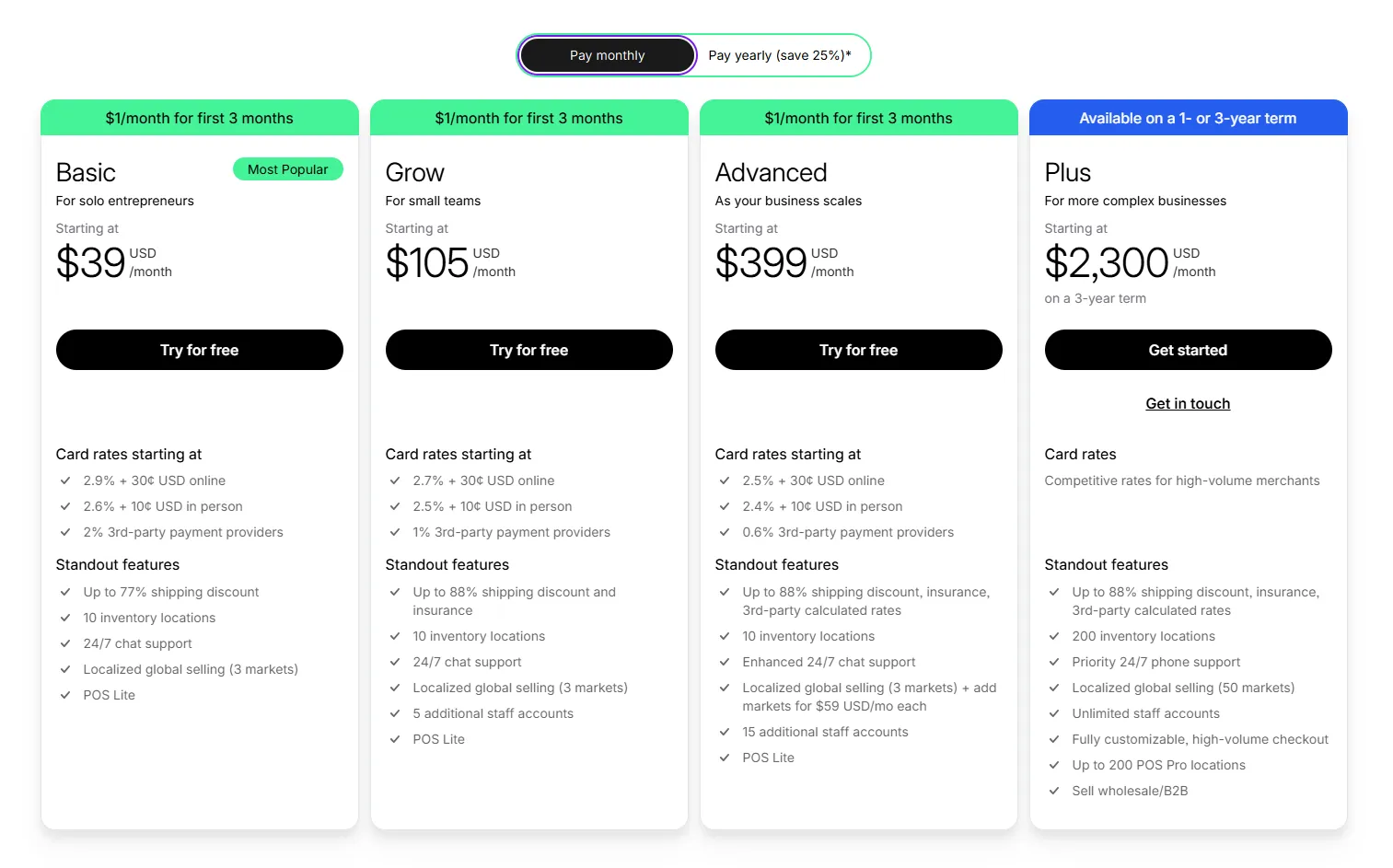
Shopify operates on a subscription-based pricing system, meaning businesses pay a fixed monthly fee to use the platform. New users can start with a promotional offer of $1 per month for the first three months, after which standard pricing applies based on the selected plan.
The Basic plan starts at $29 per month when billed annually or $39 per month when billed monthly. This plan is ideal for individual entrepreneurs, creators, and small business owners who are launching their first online store and require essential eCommerce features without complex functionality.
For growing businesses, the Grow plan begins at $79 per month when billed annually or $105 per month when billed monthly. This plan is designed for small teams, MSMEs, and businesses with consistent sales volume that need more advanced reporting and operational capabilities.
The Advanced plan starts at $299 per month when billed annually or $399 per month when billed monthly. This plan is suitable for mid-sized businesses managing high order volumes, multiple staff members, and international sales. It serves as a stepping stone for businesses preparing to scale toward enterprise-level operations.
For large enterprises, Shopify Plus is available at approximately $2,300 per month with a three-year commitment. This plan is built for high-growth companies and brands with large inventories, complex workflows, and advanced customization requirements. Shopify Plus also provides enhanced automation, dedicated support, and enterprise-grade performance.
In addition to the monthly subscription fee, Shopify users may incur additional costs depending on their business requirements. Payment processing fees typically amount to 2.9% plus $0.30 per transaction. Businesses that use Shopify’s shipping services may also pay shipping label fees, while premium apps and third-party integrations can add to the overall cost.
To understand the real-world cost, consider a store generating $5,000 in monthly revenue. Depending on the selected plan, payment gateway, and app usage, the total monthly expense may range from approximately $75 to $200. However, businesses that choose not to use Shopify Payments may face extra transaction fees, which can slightly reduce profit margins on each sale.
Unlike Shopify, Etsy does not charge a mandatory monthly subscription fee for standard sellers. Instead, it follows a transaction-based pricing model where sellers pay fees for listings and completed sales. This structure makes Etsy attractive for beginners, but the cumulative fees can become significant as sales volume increases.
Etsy charges a listing fee of $0.20 per item, which remains active for four months or until the product is sold. When a sale occurs, Etsy applies a transaction fee of 6.5% on the total order value, including the product price, shipping, and gift wrapping. Additionally, payment processing fees vary by country but are typically around 3% plus $0.25 per transaction.
Etsy also charges offsite advertising fees for sales generated through external ads run by Etsy. These fees range from 12% to 15% depending on the seller’s annual revenue. Currency conversion fees and optional Etsy Ads for internal promotion can further increase overall costs.
While Etsy’s pricing model eliminates fixed monthly expenses, the percentage-based fees can significantly impact profitability, especially for sellers with high order volumes or premium-priced products. As businesses grow, many sellers find that Shopify’s subscription-based model offers greater financial predictability and better long-term value compared to Etsy’s variable fee structure.
Although both platforms make it easier to sell online, Shopify and Etsy operate in distinct ways. When starting an online store, it is essential to evaluate multiple factors that can impact your business growth and overall performance.
The setup process is another major difference between Shopify and Etsy. Etsy is designed for simplicity and speed. Creating an Etsy shop typically takes only a few minutes. Sellers can upload product images, write descriptions, set prices, and start selling almost immediately. Because Etsy provides a pre-built template, there is no need for technical knowledge or design customization.
Shopify requires more initial setup but offers greater flexibility. Users must choose a theme, configure payment gateways, set up shipping rules, and customize store pages. Although the process takes more time compared to Etsy, Shopify’s intuitive interface and drag-and-drop editor make it accessible even to non-technical users. The additional effort invested in setup results in a more professional and scalable online store.
Brand identity plays a crucial role in the success of an online business. Etsy offers limited customization options, meaning most shops look similar in design. While sellers can upload logos and product images, the overall layout, fonts, and user experience are controlled by Etsy. This makes it difficult to build a unique brand identity.
Shopify, on the other hand, provides complete creative freedom. Sellers can customize their website design, colors, typography, layout, and functionality. Custom domains further enhance brand credibility, allowing businesses to operate under their own web address instead of a marketplace URL. This level of customization makes Shopify an ideal choice for businesses that want to establish a strong brand presence.
Both Shopify and Etsy offer essential eCommerce features, but Shopify provides more advanced tools for managing and scaling a business. Shopify’s inventory management system allows sellers to organize products into collections, manage variants, and track stock levels efficiently. The Shopify App Store offers thousands of integrations for marketing, analytics, automation, and customer engagement.
Etsy provides basic inventory management and limited integrations. While it is sufficient for small-scale sellers, it lacks the advanced automation and customization capabilities required for larger businesses. Shopify’s comprehensive feature set makes it a powerful platform for businesses that plan to grow beyond a small product catalog.
Marketing capabilities significantly influence long-term business success. Etsy’s built-in marketplace traffic allows sellers to reach customers without investing heavily in external marketing. Product visibility depends on factors such as keywords, reviews, and sales history. This makes Etsy an attractive option for beginners who want immediate exposure.
Shopify stores rely on external marketing channels such as search engines, social media, and paid advertising. Although this requires more effort and strategic planning, Shopify offers superior SEO capabilities and long-term organic growth potential. Businesses can build email lists, retarget customers, and develop comprehensive marketing strategies, which is not possible on Etsy due to limited access to customer data.
Scalability is a critical factor for businesses with long-term ambitions. Shopify is built for growth, supporting multi-currency transactions, international shipping, and advanced analytics. Businesses can upgrade plans and integrate third-party tools as they expand. Shopify Plus further enables enterprise-level automation and customization.
Etsy is suitable for small to medium-scale sellers but may become restrictive as a business grows. While Etsy can handle large order volumes, it remains a marketplace with limited branding and customization options. Many successful sellers eventually migrate from Etsy to Shopify to gain greater control over their business operations.
Both Shopify and Etsy offer secure payment processing and fraud protection. Shopify provides 24/7 customer support through live chat and email, along with built-in SSL certificates and PCI compliance. Etsy offers community forums and help resources, but direct support can be slower compared to Shopify.
From a security perspective, both platforms are reliable, but Shopify’s infrastructure is generally considered more robust and scalable.
Choosing between Shopify and Etsy depends on your business model, budget, and long-term goals. Etsy is ideal for sellers who want to start quickly, test product ideas, and leverage an existing marketplace audience. Shopify is better suited for businesses that want to build a strong brand, scale operations, and maintain full control over their online presence.
In 2026, many successful entrepreneurs use both platforms strategically. They start with Etsy to validate products and later transition to Shopify to establish their own brand identity. This hybrid approach allows businesses to benefit from Etsy’s marketplace traffic while leveraging Shopify’s scalability and branding capabilities.
There is no universal answer to whether Shopify or Etsy is better. Each platform serves a different purpose. Etsy offers convenience and immediate access to customers, while Shopify provides long-term growth opportunities and complete brand control.
For businesses that aim to build a sustainable and scalable online brand, Shopify is often the superior choice. However, Etsy remains a valuable platform for testing products and generating initial sales.
At Memento Tech, we help businesses choose the right eCommerce platform and build high-performing online stores tailored to their goals. Whether you are launching a new store or scaling an existing business, our experts can guide you through every step of the process.
Choosing the right Shopify development partner can have a direct…
Read More
The ecommerce industry in the UK is growing faster than…
Read More
Search engine optimization is changing fast in 2026. Traditional SEO…
Read More
E-commerce in India is growing fast, and Shopify is one…
Read More
Are you looking to build a creative career with high…
Read More
Are you confused about which digital marketing institute to join…
Read More
Why Your Toronto Business Needs a Shopify Expert in 2026…
Read More
Introduction – Why Choosing the Right Shopify Partner Matters Canada’s…
Read More
Search has fundamentally changed in 2026 — and your Shopify…
Read More
Choosing the right name is one of the most important…
Read More
Connect instantly with Memento Tech Service experts via WhatsApp for fast, reliable technical assistance.
Professional IT Assistance provides reliable support for your technical and business needs. Consultation is available to help you get expert guidance for your IT challenges. Our experienced IT specialists are skilled in marketing, development, websites, and systems, ensuring high-quality service. We also offer flexible support availability, providing assistance based on your specific service requirements.