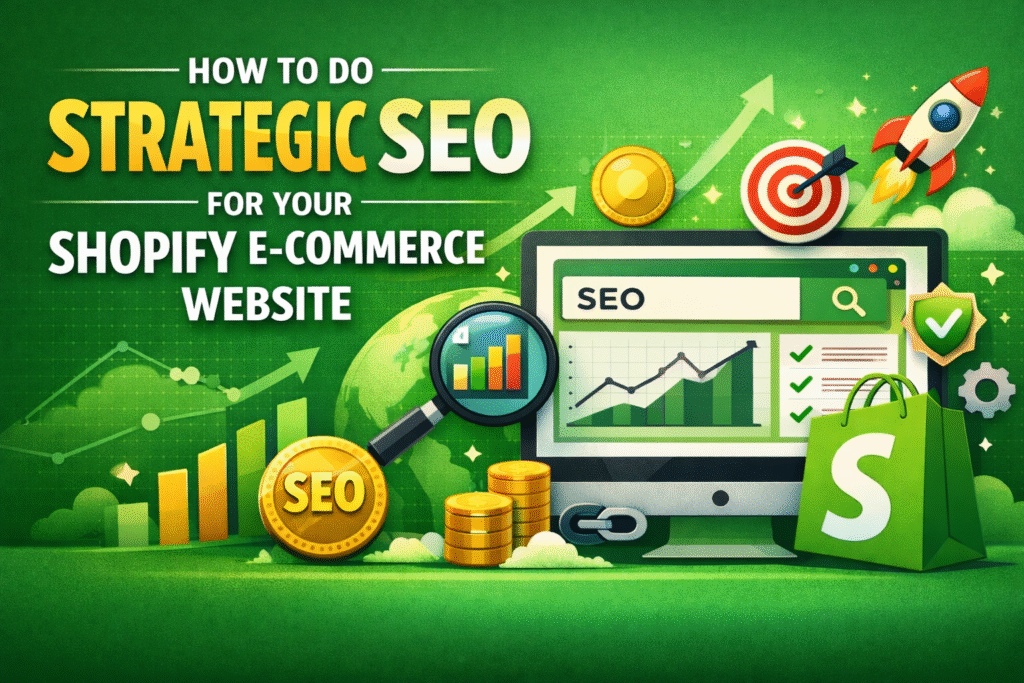
How to do strategic SEO for your Shopify e-commerce website?
Search has fundamentally changed in 2026 — and your Shopify SEO strategy needs to catch up. Google’s AI Overviews, zero-click results, and the rise of GEO (Generative Engine Optimization) have rewritten the rules of organic traffic. The Shopify stores that are winning aren’t the ones chasing old-school keyword tricks — they’re the ones building real authority, deep content, and blazing-fast experiences that both Google and AI systems trust.
At Memento Technologies, we’ve built this fully updated Shopify SEO strategy for 2026 to cut through the noise. Whether you are launching your first store or scaling to seven figures, this guide gives you a complete, Yoast-optimized, battle-tested playbook — built for the way search actually works today.
Quick Stat: 68% of all trackable website traffic still comes from organic search in 2026. The #1 result on Google captures 27.6% of all clicks. SEO is not dead — it just got smarter.
1. What’s New in Shopify SEO Strategy 2026 — The Big Shifts
Before diving into tactics, you need to understand what changed. The 2026 SEO landscape is fundamentally different from even 12 months ago. Here is what every Shopify store owner must know:
AI Overviews & Zero-Click Search
Google’s AI Overviews (formerly SGE) now appear for over 60% of commercial queries. This means users often get answers directly in Google without clicking. Your Shopify SEO strategy 2026 must optimize for being cited inside these AI summaries — not just ranking #1 on the blue links.
GEO — Generative Engine Optimization
GEO is the new SEO. It means structuring your content so AI systems (Google AI Mode, ChatGPT, Perplexity) cite your Shopify store when summarizing answers. GEO requires original data, clear expertise signals, structured content, and trustworthy E-E-A-T — all of which we cover below.
E-E-A-T Is Now Non-Negotiable
Experience, Expertise, Authoritativeness, and Trustworthiness (E-E-A-T) is Google’s framework for evaluating content quality. In 2026, for e-commerce, this means visible author credentials, verified reviews, clear return/shipping policies, and original product expertise — not just keyword-stuffed pages.
Search Everywhere Optimization
SEO in 2026 is not just Google. Your audience is discovering products on TikTok, Reddit, YouTube, Instagram, and Pinterest. A full Shopify SEO strategy now includes optimizing presence across all platforms where your buyers search.
Voice Search Grew 35% Year-Over-Year
Voice queries are conversational and question-based. Optimizing for natural language (‘Where can I buy vegan leather wallets near me?’) is now a core part of the Shopify keyword strategy.
2026 Key Shift: Stop optimizing just for Google blue links. Optimize for AI citation, voice answers, social discovery, and zero-click summaries. These are the new traffic sources that compound.
2. Keyword Research for Shopify in 2026: Intent First, Volume Second
The foundation of any successful Shopify SEO strategy in 2026 is understanding search intent — not just volume. Google’s AI now interprets the motivation behind a query, not just the words in it. Your keywords must map to exactly why someone is searching.
The 4 Intent Categories — Know These Cold:
Informational: ‘How to clean suede shoes’ → target with blog content
Start with Ahrefs, SEMrush, or Google Keyword Planner — identify 20–30 seed keywords in your niche.
Filter for buyer-intent long-tail keywords (3–5+ words). Example: ‘slim bifold wallet full-grain leather’ beats ‘leather wallet’ every time.
Use Google’s ‘People Also Ask’ boxes — these are goldmines for blog topics and FAQ schema.
Check TikTok and Reddit for what your audience calls your products in real language.
Use Ahrefs’ Personal Keyword Difficulty (AI-powered in 2026) to find low-competition wins for your specific domain.
Map every keyword to a specific page type: product, collection, or blog. Never target the same keyword on two pages.
Include voice search variants: question-format keywords (‘What is the best…’, ‘How do I…’)
Topic Clusters — The 2026 Content Power Move:
Build a topic cluster strategy: one comprehensive Pillar Page targeting a head keyword, supported by 6–10 cluster blog posts targeting related subtopics. All cluster posts link back to the pillar. This tells Google you are the authority on the entire topic — not just one page.
Pro Tip: In 2026, rank for ‘best
14%
$45.00Original price was: $45.00.$39.00Current price is: $39.00.
for [specific use case]’ keywords. These commercial-intent long-tails drive qualified buyers and are easier to rank for than generic terms. Voice search grew 35% YoY — optimize every product FAQ for natural language questions.
3. On-Page SEO: Optimize Every Element of Your Shopify Store
On-page SEO is the most direct lever in your Shopify SEO strategy 2026. In an AI-first search world, every page element sends signals to both Google’s ranking algorithm and AI summary systems.
Title Tags & Meta Descriptions
Title tag: 50–60 characters. Place your primary keyword in the first 3 words. Add a power word and brand name. Example: ‘Shopify SEO Strategy 2026: Complete Guide | Memento Technologies’
Meta description: 120–155 characters. Include focus keyword, a clear value proposition, and a soft CTA. Example: ‘Learn the complete Shopify SEO strategy for 2026. Rank higher, attract more buyers, and grow organic revenue — by Memento Technologies.’
In Shopify, edit these under ‘Search engine listing preview’ on every product, collection, and page.
URL Structure
Keep URLs short, descriptive, and keyword-rich: yourstore.com/collections/mens-leather-wallets
Avoid dynamic parameters and auto-generated numbers in URLs.
Never change URLs of existing, ranking pages without setting up 301 redirects.
Product Pages — The 2026 Standard
Product pages are the revenue engine. In 2026, thin product pages are penalized. Here is the minimum standard:
Unique product title containing primary keyword — never copy manufacturer titles.
300–500 words of original product description (not supplier copy).
Focus keyword in first 100 words of the description.
H1 tag = product name + key modifier. Use one H1 only per page.
Use H2/H3 subheadings for features, materials, sizing, care instructions.
Add descriptive image alt text to every product photo.
Include structured data: Product schema with price, availability, and review rating.
Add a visible FAQ section on high-value product pages — this feeds Google’s ‘People Also Ask’ and AI Overviews.
Collection Pages
Collection pages often rank for the highest-volume category keywords. Add 150–300 words of keyword-optimized intro text above the product grid. Use your target keyword naturally in the first sentence. Include internal links to related collections.
E-E-A-T Signals on Every Page
Show author bio with credentials on blog posts.
Display real customer reviews with verified purchase badges.
Link to clear return, refund, and shipping policy pages.
Include ‘About Us’ and contact information that establishes your brand’s real-world presence.
4. Technical SEO 2026: Speed, Crawlability, and AI Readiness
Technical SEO is the backbone of your Shopify SEO strategy in 2026. Google cannot rank what it cannot crawl and understand. AI systems cannot cite what is not structured clearly. Here is what to audit and fix immediately.
Core Web Vitals — Still the Performance Benchmark
With 87% of smartphone users using search engines daily, slow pages directly cost you customers and rankings.
LCP (Largest Contentful Paint): Under 2.5 seconds. Optimize hero images, compress all product photos to WebP.
FID/INP (Interaction to Next Paint): Under 200ms. Reduce JavaScript execution time. Audit and remove unnecessary Shopify apps.
CLS (Cumulative Layout Shift): Under 0.1. Set explicit width/height attributes on all images and embeds.
Use Lighthouse in Chrome DevTools or Google Search Console’s Core Web Vitals report to audit monthly.
Leverage Shopify’s built-in CDN — it serves assets from nearby nodes globally, improving load times automatically.
Mobile-First Is Non-Negotiable in 2026
Mobile generates 79% of all Shopify traffic. Google uses mobile-first indexing exclusively. If your mobile experience is broken, you do not rank — period.
Test every page with Google’s Mobile-Friendly Test.
Design for thumb-first UX: buttons minimum 44px tap targets, easy navigation.
Ensure product images, videos, and tabs load correctly on iOS and Android.
Check that pop-ups and interstitials are not blocking content on mobile.
Site Architecture & Crawlability
Submit your XML sitemap (yourstore.com/sitemap.xml) to Google Search Console immediately.
Review robots.txt — ensure you are not accidentally blocking important pages or product categories.
Keep your navigation flat: any page should be reachable within 3 clicks from the homepage.
Fix all 404 errors immediately. Set up 301 redirects for any deleted or moved pages.
Use Google Search Console’s URL Inspection tool to verify any page is indexed correctly.
Structured Data / Schema Markup — Critical for AI Overviews
Schema markup is more important in 2026 than ever because it feeds directly into Google AI Overviews and rich results. Implement:
Review snippet schema: Show star ratings in SERPs — dramatically improves CTR.
FAQPage schema: Answers appear directly in Google SERPs and AI Overviews.
BreadcrumbList schema: Helps Google understand your site structure.
Article schema: For all blog posts — required for news-style rich results.
Duplicate Content — Shopify-Specific Issues
Shopify auto-generates canonical tags — verify they point to the correct URL for product variants.
Check that collection filter pages (e.g., ?sort_by=price) are not creating indexed duplicates.
Ensure product pages appearing in multiple collections have a single canonical URL.
2026 Technical Priority: Structured data (schema markup) is now the single most important technical SEO investment for Shopify stores. It directly feeds Google AI Overviews, voice search answers, and rich snippet results. If you do nothing else from this section, implement Product + FAQPage + Review schema today.
5. GEO — Generative Engine Optimization: The 2026 Game-Changer
GEO is the biggest new addition to any Shopify SEO strategy in 2026. As more users discover products through ChatGPT, Perplexity, Google AI Mode, and AI Overviews, optimizing to be cited by AI systems is now as important as ranking in traditional blue links.
How to Optimize Your Shopify Store for GEO:
Write comprehensive, well-structured content that directly and fully answers specific customer questions. AI systems prefer content that is clear, authoritative, and cites original data.
Use original research and data. AI systems preferentially cite original sources (your own studies, survey results, product test data) over aggregated content.
Structure content with clear H2/H3 headings, bullet points, and concise answers — AI models extract well-formatted content more reliably.
Implement FAQPage schema on product and collection pages. These FAQ blocks feed directly into AI summaries.
Build strong E-E-A-T signals (see Section 3). AI systems are trained to prioritize trustworthy, expert sources.
Get cited on authoritative third-party sites (reviews, press, industry blogs). AI models use these external citations as trust signals.
Optimize for Bing AI Chat and Perplexity separately — these systems use different ranking signals than Google and are growing fast in e-commerce discovery.
GEO in Action: A Shopify store that added detailed FAQs with original product testing data to their collection pages saw a 60% jump in relevant search traffic within 90 days — driven largely by AI Overview citations and featured snippets.
6. Content Marketing 2026: Build a Topic Authority Engine
Blogging remains one of the most powerful components of your Shopify SEO strategy 2026 — but the approach has changed. Generic 500-word posts are worthless. You need deep, intent-matched, topically authoritative content that satisfies your buyer’s entire journey and gives AI systems something worth citing.
Content Types That Win in 2026:
Comprehensive buying guides: ‘The Complete Guide to Men’s Leather Wallets in 2026’ — 2,000+ words, original expertise, product comparisons.
Problem-solution posts: Directly answer the ‘People Also Ask’ questions Google shows for your category keywords.
Comparison content: ‘[Your Product] vs [Competitor]’ — high commercial intent, captures buyers in decision stage.
Original data and research: Run a survey or product test, publish the results — AI systems love original data sources.
Video tutorials and product demos: Embed YouTube videos in blog posts. Video content is increasingly cited in Google results.
Customer success stories: Real-world E-E-A-T signals with keyword-rich narrative.
Yoast SEO Blog Writing Rules — 2026 Checklist:
Focus keyword in SEO title, first paragraph, at least 1 H2, and meta description.
Aim for 1,500–3,000 words for competitive topics. Quality over length, always.
Paragraphs maximum 3–4 sentences. No walls of text.
30%+ of sentences use transition words (Furthermore, In addition, As a result, However, Therefore).
Flesch Reading Ease score above 60 — write like you talk, not like a textbook.
1 internal link to a product or collection page per blog post.
1–2 external links to authoritative sources (Google documentation, credible industry sites).
End every post with a clear CTA linking to your most relevant product or collection.
Add FAQPage schema to every post — these appear in AI Overviews.
Publish on a consistent schedule: minimum 2 posts per week for fastest momentum.
7. Search Everywhere Optimization: Beyond Google in 2026
A complete Shopify SEO strategy in 2026 extends beyond Google. Your customers search on multiple platforms, and each requires a tailored optimization approach.
TikTok SEO
Optimize video captions and audio scripts with your product keywords.
Use trending sounds paired with product-specific keywords in captions.
TikTok’s native search is now a primary discovery tool for Gen Z shoppers. Product hashtags and keyword-rich descriptions directly improve TikTok search visibility.
YouTube SEO
Create product demo, unboxing, and tutorial videos. Optimize titles, descriptions, and tags with Shopify product keywords.
YouTube videos appear in Google image and video search — and in Google AI Overviews when relevant.
Add a link to your Shopify product page in every video description.
Pinterest SEO
Pinterest is a visual search engine. Optimize pin titles and descriptions with product keywords.
Use rich pins to pull live product data (price, availability) directly from your Shopify store.
Reddit & Community SEO
Monitor relevant subreddits where your buyers discuss products. Engage authentically — Reddit threads increasingly appear in Google results.
Answer questions in relevant communities with genuine expertise. This builds brand authority that eventually surfaces in AI systems.
8. Link Building in 2026: Authority Signals That Still Move Rankings
Backlinks remain one of Google’s top three ranking factors in 2026. Building high-quality, relevant links is a non-negotiable part of your Shopify SEO strategy.
The Most Effective Link Building Tactics for Shopify 2026:
Supplier and manufacturer links: If you sell products from established brands, email them asking for an authorized retailer link from their website. These are free, highly relevant, and easy to get.
Product PR and blogger outreach: Send products to relevant bloggers, journalists, and influencers for honest reviews. Media coverage generates powerful editorial backlinks.
Digital PR with original data: Publish a study, survey, or original industry data. Data-driven content attracts natural editorial links from journalists and industry sites.
Guest blogging: Write expert posts on industry blogs. Link to relevant content on your Shopify store within the article.
Broken link building: Find broken links on competitor-adjacent sites using Ahrefs. Offer your relevant content as a replacement.
Resource page inclusion: Identify ‘best of’ and ‘resource’ pages in your niche. Pitch your store or guide for inclusion.
Reclaim unlinked brand mentions: Search for mentions of your brand or store name that do not include a link. Email the site owner and ask them to add the link.
Competitor backlink replication: In Ahrefs or SEMrush, export your top competitor’s backlinks. Identify sources you can also earn links from and reach out systematically.
2026 Link Quality Rule: One link from a DR 60+ relevant industry site is worth more than 100 links from generic directories. Focus on relevance and authority over volume. Toxic link profiles from low-quality sources can still trigger Google penalties.
9. Local SEO for Shopify 2026: Dominate Your Geographic Market
If your Shopify store has a physical presence or ships within a specific region, local SEO is a high-ROI, often overlooked component of your overall strategy.
Claim and fully optimize your Google Business Profile: complete every field, add product photos, respond to every review within 24 hours.
Include location-specific keywords on your product and collection pages (e.g., ‘handmade leather goods — Mumbai’).
Create dedicated landing pages for each city or region you serve.
Build local citations: ensure your business name, address, and phone number (NAP) is consistent across all directories.
Publish local content: blog about local events, news, or stories related to your product category.
Earn reviews on Google, Trustpilot, and local directories — review volume and recency directly impact local pack rankings.
10. The Complete Shopify SEO Strategy 2026 Checklist
Run through this checklist every quarter to ensure your Shopify store is fully optimized:
Technical SEO
Google Search Console set up, sitemap submitted, no critical errors
Every blog post targets a specific focus keyword with Yoast green bullets
FAQPage schema on all blog posts and key product pages
Original data or research published in the last 90 days
Video content embedded on key product and blog pages
Off-Page & Authority
Minimum 3 high-quality backlinks acquired in the last 30 days
Google Business Profile fully optimized (if applicable)
Brand mentions monitored and unlinked mentions converted to links
Competitor backlink gap analysis completed in last quarter
Presence active on TikTok, YouTube, or Pinterest with keyword-optimized content
11. Tracking & Measuring Your Shopify SEO Strategy in 2026
Data is the only way to know if your strategy is working. Set up these measurement systems from day one:
Essential Tools:
Google Search Console: Track impressions, clicks, average position, Core Web Vitals, and indexing issues. Your #1 SEO intelligence source — free.
Google Analytics 4: Monitor organic traffic, engagement rate, conversion rate, and revenue from organic search.
Ahrefs or SEMrush: Track keyword rankings, backlink profile growth, competitor movements, and content gap opportunities.
Shopify Analytics: Cross-reference which traffic sources drive the most revenue. Connect organic growth to actual store sales.
Monthly SEO Review Actions:
Review top 20 landing pages from organic search in GA4 — are they ranking for the right keywords and converting?
Check Google Search Console for new crawl errors, manual actions, or indexing drops.
Update and refresh any blog posts that dropped in ranking — add new data, expand thin sections, improve internal links.
Review backlink profile for toxic links. Disavow if necessary.
Identify new keyword opportunities from Search Console’s ‘Queries’ report — pages ranking positions 5–20 are prime for optimization.
Check if new AI Overview features have appeared for your target keywords — adjust content to improve citation chances.
Conclusion: Your Shopify SEO Strategy 2026 Starts Now
The rules of search have changed — but the opportunity has never been bigger. A well-executed Shopify SEO strategy in 2026 means optimizing for Google, AI Overviews, voice search, and social discovery simultaneously. The brands that combine technical excellence, deep content authority, strong E-E-A-T signals, and GEO readiness will dominate organic traffic for years.
Unlike paid ads that disappear the moment you stop spending, SEO compounds. A page you optimize today keeps generating traffic for months and years. That is the power of building organic authority — it is the highest-ROI growth channel available to any Shopify store in 2026.
At Memento Technologies, we build custom Shopify SEO strategies that deliver measurable, sustainable growth. From full technical audits to content strategy and GEO optimization, we turn organic search into your most powerful revenue engine.
🚀 Ready to dominate search in 2026? Contact Memento Technologies for a free Shopify SEO audit. We will identify exactly what is holding your store back — and build a strategy to fix it.
FAQ
How long does a Shopify SEO strategy take to show results in 2026?
Most Shopify stores see measurable organic traffic improvements within 3–6 months. Competitive niches may take 6–12 months for significant ranking movement. However, technical fixes and schema implementation can produce quick wins (featured snippets, rich results) within weeks.
What is GEO and why does it matter for Shopify SEO in 2026?
GEO stands for Generative Engine Optimization — the practice of structuring your content so AI systems like Google AI Overviews, ChatGPT, and Perplexity cite your store in their summaries. As zero-click search grows, GEO is now as important as traditional keyword ranking.
Does Shopify handle SEO automatically?
Shopify provides a solid technical foundation — SSL, canonical tags, CDN, and auto-generated XML sitemaps. However, you still need to actively implement keyword strategy, on-page optimization, content marketing, schema markup, and link building. Shopify does the basics; you do the strategy.
What is the most important Shopify SEO change for 2026?
The single most important shift is optimizing for AI citation (GEO). With Google AI Overviews appearing on over 60% of commercial queries, your content must be structured to be cited by AI — not just ranked in blue links. This means original data, clear structure, FAQPage schema, and strong E-E-A-T signals.
Which Shopify SEO tools are best in 2026?
The must-have stack: Google Search Console (free, essential), Ahrefs or SEMrush (keyword and backlink tracking), Yoast SEO or Plug in SEO (on-page optimization), and Google Analytics 4 (performance measurement). For schema, use Shopify's built-in structured data plus a dedicated JSON-LD app for FAQPage and Review schemas.
This website uses cookies to ensure you get the best experience on our website.
×
Loading...
Need Immediate IT Support?
Connect instantly with Memento Tech Service experts via WhatsApp for fast, reliable technical assistance.
Professional IT Assistance provides reliable support for your technical and business needs. Consultation is available to help you get expert guidance for your IT challenges. Our experienced IT specialists are skilled in marketing, development, websites, and systems, ensuring high-quality service. We also offer flexible support availability, providing assistance based on your specific service requirements.